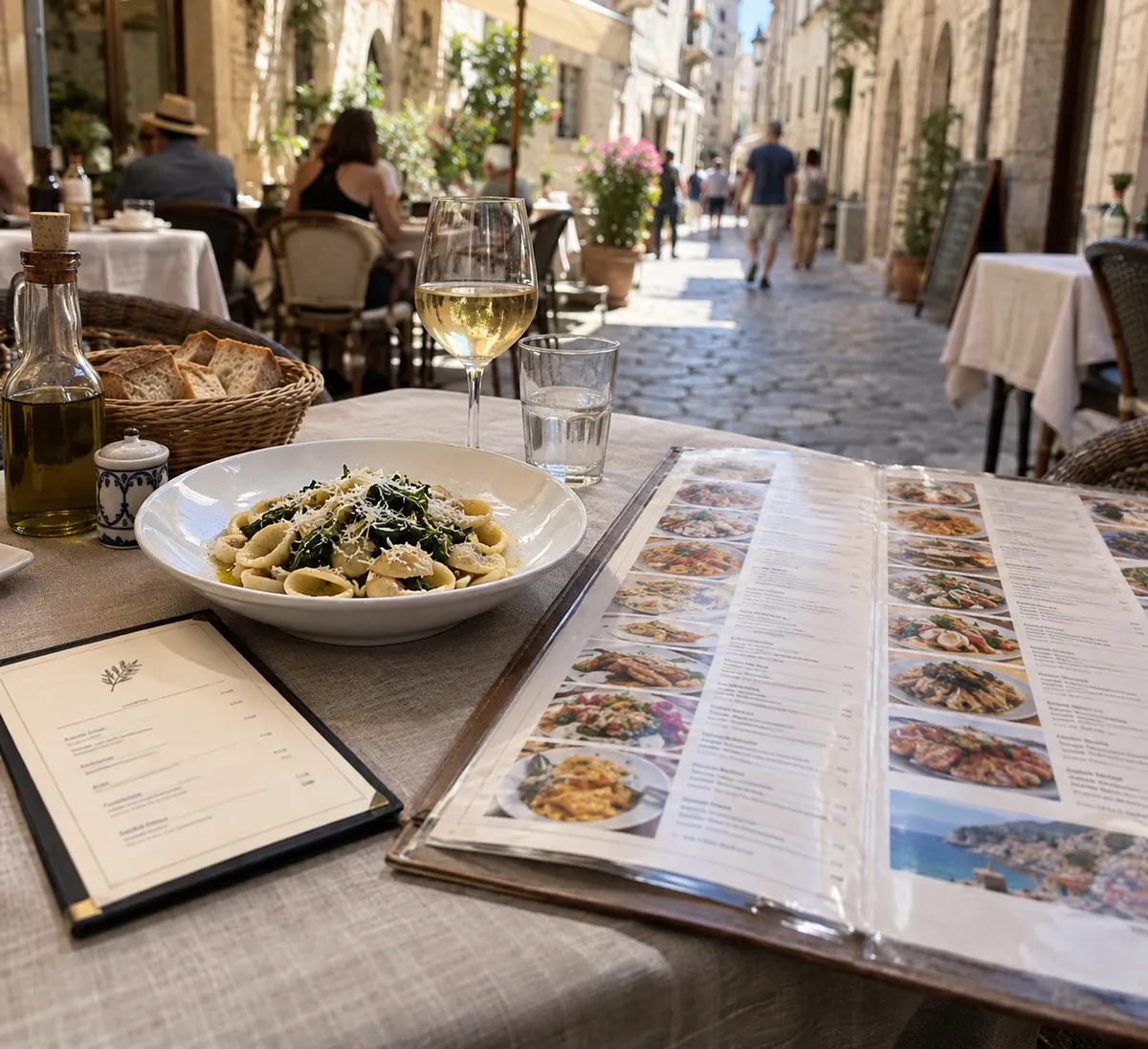
You're hungry, the square is gorgeous, and every restaurant has a laminated menu with photos. Which one do you pick? Food & Wine recently highlighted a simple rule from travel expert Rick Steves for exactly this moment: skip the tourist-trap menus and look for places that cater to locals. By the end of this guide, you'll know how to read a menu from the sidewalk before you ever sit down.
The core idea, per Food & Wine, is that a restaurant's menu design, language, and size can reveal whether it offers authentic, worthwhile food. The menu is the first clue, and you can check it for free.
The Rule in One Sentence
Eat where the locals eat. A restaurant built for local customers has different priorities than one built for passing visitors, and that difference tends to show up on the menu. Food & Wine's summary of Steves' advice points to three things worth checking: design, language, and size.
Treat these as clues rather than guarantees. One signal alone proves little, but several together usually tell the story.
Clue 1: Look at the Language
A menu written only in the local language suggests a kitchen aimed at people who already know the dishes. A menu translated into many languages suggests the opposite: a business built around people who are just passing through.
This doesn't mean a translation is bad. Many good restaurants offer one for helpfulness. The signal is when translation is the main event, with the local language almost an afterthought.
What to do: Pull out a translation app and point your phone at a menu in the local language. Working out a few dishes is part of the fun, and it often leads you to the regional specialties you came for.
Clue 2: Look at the Design
Menu design often gives away a restaurant's audience. Glossy, photo-heavy menus aimed at attracting a glance from the street tend to be a sign of tourist-focused dining. A plain, simple menu, sometimes just a single sheet or a handwritten list, often suggests a place more focused on the food than on the pitch.
What to do: Before sitting, ask yourself whether the menu is trying to sell you on the dish or simply tell you what's available. The second kind is usually the better bet.
Clue 3: Look at the Size
A huge menu covering every cuisine and dish imaginable is a common red flag. It's hard for any kitchen to do dozens of dishes well, especially fresh. A shorter menu usually signals a kitchen that focuses on what it does best, which often means regional dishes and what's in season.
What to do: Favor the place with a short list. If the menu runs several pages and covers pasta, burgers, paella, and sushi all at once, keep walking.
A 30-Second Sidewalk Check
You can run this routine before committing to any table:
- Read the language. Is it mostly the local language, or a stack of translations?
- Scan the design. Photos and flashy graphics, or a simple list?
- Count the pages. Short and focused, or sprawling?
- Look at who's eating. This follows Steves' basic idea: if the room is full of locals, you're probably in the right place.
Two or more red flags? Move on. Crowded destinations are where this matters most, since tourist-focused restaurants dominate the streets right around major sights, according to the Food & Wine framing.
Use the Rule to Find Regional Dishes
The real payoff isn't just avoiding overpriced meals. A local-focused menu is where regional cooking lives. A short list in the local language is more likely to feature the dishes that define a place, the ones you'd otherwise miss while ordering something generic from a photo.
Try this approach in any city:
- Ask what's good today. Even with limited language, pointing at a menu and asking is a friendly way in.
- Look for dishes you don't recognize. Unfamiliar names often mean local specialties.
- Walk a few streets away from the main attractions. Distance from the big sights is a practical way to find restaurants that depend on repeat local customers.
That last tip is my own common-sense addition rather than something attributed to Steves, but it pairs naturally with his rule.
Common First-Trip Dining Mistakes
A few errors this rule helps you avoid:
- Choosing by photos. Pictures on a menu are a sales tool, not a quality guarantee.
- Picking the view over the food. A prime spot beside a famous landmark often comes with a menu aimed at visitors.
- Trusting a menu that offers everything. Breadth usually costs depth.
A Simple Habit to Carry With You
Next time you're standing in front of a restaurant, spend thirty seconds on the menu before you spend an hour at the table. Check the language, the design, and the length, then choose the place that looks like it's cooking for its neighbors.